
Theodore Roosevelt's Boundless West!
Is This Another Unearthed TR Historical Treasure - Of the Literary/Poetic Variety?

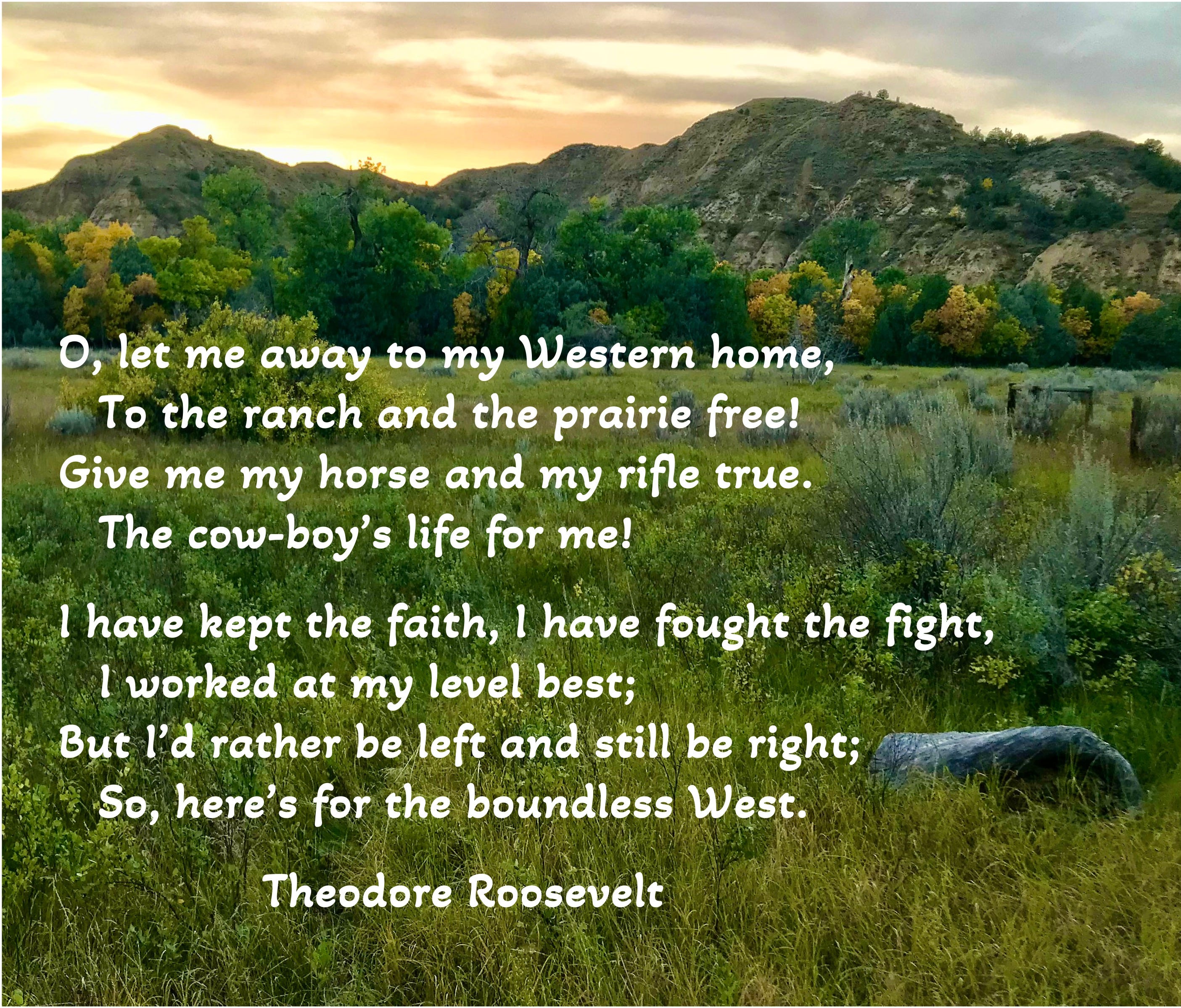
I was recently digging through some of Theodore Roosevelt’s (TR’s) mid 1880s history to try and determine when he first met (or came across for the first time) Booker T. Washington. As is often the case, when I’m digging around for one thing related to TR, I find something completely different, unexpected, exciting, and in this case, potentially of profound historical value. In the November 4 issue of The Buffalo Express, I came across this brief poem, which was directly attributed (in a byline) to “Theodore Roosevelt.” It was reprinted that same day in The Buffalo Weekly Express edition, where the byline was confirmed, but beyond that, I haven’t seen any other mention of the text – anywhere. It’s almost as if these eight poetic lines of TR’s, when he was in the midst of one of the biggest transitions of his life, had been immediately lost to history. I have taken the liberty to informally title the poem as Theodore Roosevelt’s Boundless West!
November 4 was just two days after TR had gotten trounced in the New York City Mayoral election, coming in third place. He was getting ready to depart for England in just two days, where he was to be married in December to his second wife, Edith. At the time, perhaps TR felt his political career was over and he was finally getting ready to move more emphatically toward staking his future on the West, instead of the East, after he returned from his wedding celebrations and honeymoon. Ranching in the Dakota Territory was tough business in those days and his two backwoods partners from Maine (Bill Sewall and Wilmot Dow) had recently departed the Elkhorn Ranch with their families to move back to Island Falls in the North Woods of Aroostook County.
O, let me away to my Western home,
To the ranch and the prairie free!
Give me my horse and my rifle true.
The cow-boy’s life for me!
I have kept the faith, I have fought the fight,
I worked at my level best;
But I’d rather be left and still be right;
So, here’s for the boundless West.
TR had a passion for reading poetry, but not so much for writing it. He had a long and vibrant literary career, authoring dozens of books and hundreds of articles, but poetry was not his chosen endeavor, focus, or forte. For that reason alone, the eight lines above are noteworthy. At first glance, each of the lines evoke quintessential TR-type images – in the first quatrain his home on the range, his Elkhorn ranch and surrounding terrain, his love or horseback riding, cowboy life, and hunting big game. In the second quatrain, there are also his Biblical references to keeping the faith, fighting the good fight, working hard, and always striving in the arena for what is right. It all oozes TR’s western ethos and zest for strenuous living. The questions quickly become - did he really write these words? And if he did, do they rank as some of the best he ever authored on his beloved West?
Conceptually, the earliest TR could have drafted this poem would have been sometime on November 2, once he had definitively lost the Mayoral race and his future fate had been sealed. That said, and knowing he would likely lose the election, he could have been pondering the words, and daydreaming about the west, ahead of time. As a potential clue, there was no doubt TR was thinking about the West around the time of his election loss. As reported in the November 4 issue of The Bad Lands Cow Boy, “A special telegram was received from Theodore Roosevelt by the Ferris brothers, that he was defeated in the election for mayor of New York city...He made a good fight, ably backed by the best citizens of New York but the anti-reform element was too strong.”
And as another clue, TR wrote several others around the same timeframe about his mayoral loss and pending trip to Europe (see the Theodore Roosevelt Center Digital Library). One letter he wrote was reported on in the November 6 edition of the Buffalo Commercial Advertiser, which stated, “Theodore Roosevelt sailed for Europe on the steamer Etruria today. Mr. Roosevelt shortly before his departure sent a letter to a well-known lawyer in this city in which, after announcing his intention of spending some time abroad, he said that he intended getting married as well.” TR could have easily included the poem with his letter to the Buffalo lawyer, sent it with enough time to reach Buffalo by rail, and it could have then been easily leaked to The Buffalo Express in time to be printed in their November 4 edition.
It would be difficult to imagine The Buffalo Express falsely attributing the poem to TR, given his prominence in New York. It is certainly possible, but not likely. Over time, perhaps more clues will accumulate to provide enough evidence to be absolutely 100% certain. If anyone uncovers meaningful new details, please let me know and I’ll provide an update at the end of this Post. But based on all the information I’ve included so far, I’d bet TR did write the poetic words of Theodore Roosevelt’s Boundless West. And if he did, and even while they are simplistic in nature, they would immediately take up their rightful position in the pantheon of the best short form descriptive writing Theodore Roosevelt ever authored on his love for the West.
As a final note, the winter of 1886/87 was a particularly brutal one in the Badlands and much of TR’s cattle herd was decimated. As a result, and whether he preferred to take up residence in the West or not, his future rise to greatness was in the East, where he was soon set on a path that led him directly to the honor of becoming America’s 26th President of the United States. It was many of the formative values and principles he learned and honed in the West, however, that brought him to the trailhead of his emerging American legacy.
Here’s to Theodore Roosevelt’s Boundless West!
And May God Bless America!
Update 1 (August 5, 2025): On November 2, TR spoke about his election loss to a New-York Tribune reporter at the Fifth Avenue Hotel, and stated, “The result is not a surprise to me, by any means. When I accepted the nomination I thought I was entering a hopeless fight, but I have worked just as hard as though success was easily attainable...” It was further reported, “Mr. Roosevelt, who had been dining with friends, entered the room about 8 o’clock. He had arrived at the conclusion that he was defeated early in the day, and seemed determined to show he was not down hearted. He greeted heartily his uncle, Robert B. Roosevelt...” (See New-York Tribune, November 3, 1886). Some of the language TR used, his demeanor, and the fact he knew he had been defeated early in the day are all supportive clues of TR authoring this poem. And given it was election night, there were plenty of friends, acquaintances, and reporters around to whom TR could have uttered his Boundless West poetic words.
Update 2 (August 5, 2025): Also late at night on November 2, the The Sun captured even closer evidence coming directly from TR, when they quoted him dreaming of the West. Under the heading “The Promises of Youth,” they reported the following: “‘To me,’ soliloquized young Mr. Roosevelt as he packed his gripsack at a late hour last night, ‘the vast and billowy prairie as it lies bathed in the golden light of the early morning sun possesses peculiar and irresistible charms. Picture to yourself,’ he went on rapturously, addressing an imaginary audience, ‘a horseman at full speed dashing across the plain, sitting his gallant steed with careless ease, his head thrown back, his chest expanded, the soft air laden with a thousand perfumes of the opening day blowing fresh and pure and sweet in his face. Ah, me! in my mind’s eye I can see – ’ ‘What time would you wish to be called in the morning, sir?’ interrupted a servant. ‘In time for the limited train West.’ And Mr. Roosevelt sank among the pillows a hearty, handsome, healthy, hopeful young citizen, with a restful past, a glorious present, and a great, big future with a capital F.” (See The Sun, November 3, 1886).
Update 3 (August 5, 2025): Theodore Roosevelt, Ansley Wilcox (a prominent Buffalo lawyer –whose home TR was publicly inaugurated in as President on September 14, 1901), and The Buffalo Express were all familiar with one another (See The Buffalo Express, August 22, and August 26, 1884).
An intriguing thought that TR might have written this brief poem. It certainly seems possible.
In a 1905 letter to Brander Matthews, Roosevelt notes that he has never written poetry - although he presumably means that in a professional sense. He produced a few lines of poetry in his childhood that survive. A c. 1892 letter to Bamie is written in a poetic form as well.
If these lines of poetry are indeed his, they are among the very few he ever produced.
Cool find!